1. Introduction
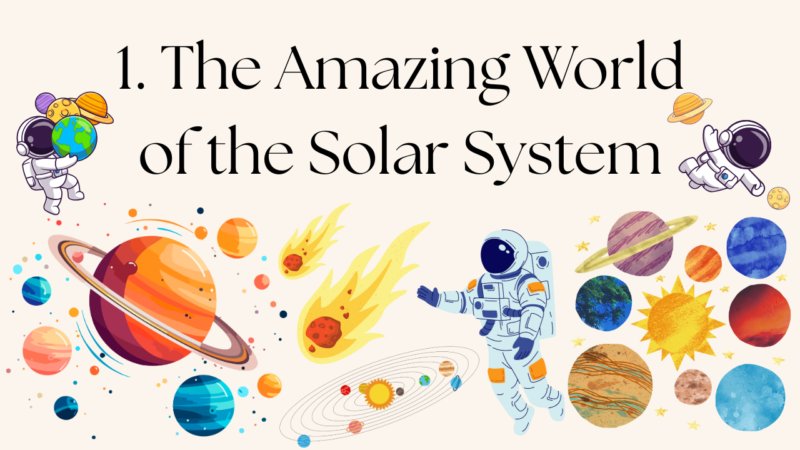
The solar system is one of the most fascinating and important parts of the universe. It is a vast system made up of the Sun, eight planets, their moons, and many other celestial objects such as asteroids, comets, and meteoroids. The solar system is our cosmic home, and Earth is a small but special part of it. Studying the solar system helps us understand how planets move, how life exists on Earth, and how the universe works.
Since ancient times, humans have looked at the sky with curiosity and wonder. Over the years, scientific discoveries and space missions have helped us learn more about the solar system. Today, it is an important subject in science and astronomy, especially for students, because it introduces them to the mysteries of space.
Table of Contents
1. The Amazing World of the Solar System on youtube
2. The Sun: The Heart of the Solar System
The Sun is the largest and most powerful object in the solar system. It is a huge ball of burning gases, mainly hydrogen and helium. The Sun produces energy through nuclear reactions, which provide heat and light to all the planets. Without the Sun, life on Earth would not be possible.
The Sun’s gravity holds the entire solar system together. All planets, asteroids, and comets revolve around it in fixed paths called orbits. Although the Sun looks small from Earth, it is actually so large that more than one million Earths could fit inside it. The Sun also controls weather, seasons, and climate on Earth.
3. The Planets of the Solar System
There are eight planets in the solar system. Each planet is unique in size, structure, atmosphere, and movement. The planets are divided into two main groups: inner planets and outer planets.
The inner planets include Mercury, Venus, Earth, and Mars. These planets are rocky and are closer to the Sun.
The outer planets include Jupiter, Saturn, Uranus, and Neptune. These are gas giants or ice giants and are much larger in size.
4. Mercury: The Closest Planet to the Sun
Mercury is the smallest planet and the closest to the Sun. It has no atmosphere to protect it, which causes extreme temperatures. During the day, Mercury becomes very hot, and at night it becomes extremely cold.
Mercury has a rocky surface filled with craters, similar to the Moon. Because it is so close to the Sun, it completes one revolution very quickly. However, its rotation is slow, making its days very long.
5. Venus: The Hottest Planet
Venus is often called Earth’s twin because it is similar in size, but its conditions are very different. Venus has a thick atmosphere made of carbon dioxide, which traps heat and makes it the hottest planet in the solar system.
The surface of Venus is rocky and volcanic. It rotates in the opposite direction compared to most planets. Because of its brightness, Venus is often visible in the sky and is sometimes called the Morning Star or Evening Star.
6. Earth: The Planet of Life
Earth is the only known planet that supports life. It has water, oxygen, a suitable temperature, and a protective atmosphere. These conditions make Earth unique in the solar system.
Earth has one natural satellite called the Moon. The Moon affects tides and stabilizes Earth’s rotation. Earth’s rotation causes day and night, while its revolution around the Sun causes seasons.
7. Mars: The Red Planet
Mars is known as the Red Planet because of its reddish appearance caused by iron oxide on its surface. Scientists believe Mars once had water, and research is ongoing to find signs of life.
Mars has the largest volcano and the deepest canyon in the solar system. It has two small moons called Phobos and Deimos. Many space missions are focused on Mars because it may be suitable for future human exploration.
8. Jupiter: The Giant Planet
Jupiter is the largest planet in the solar system. It is a gas giant made mostly of hydrogen and helium. Jupiter has a strong gravitational pull and many moons, including the largest moon, Ganymede.
One of Jupiter’s most famous features is the Great Red Spot, which is a massive storm that has existed for hundreds of years. Jupiter plays an important role in protecting inner planets by pulling asteroids away with its gravity.
9. Saturn: The Planet with Rings
Saturn is well known for its beautiful ring system made of ice, rock, and dust. It is the second-largest planet in the solar system and is also a gas giant.
Saturn has many moons, including Titan, which has a thick atmosphere. Saturn’s rings make it one of the most visually stunning planets and a favorite subject of space study.
10. Uranus: The Tilted Planet
Uranus is unique because it rotates on its side. This unusual tilt causes extreme seasons that last for many years. Uranus has a pale blue color due to methane in its atmosphere.
It is an ice giant and has a cold and windy environment. Uranus also has rings and moons, though they are less visible than Saturn’s.
11. Neptune: The Farthest Planet
Neptune is the farthest planet from the Sun and is known for its strong winds and storms. It has a deep blue color and is extremely cold.
Despite being far away, Neptune plays an important role in balancing the solar system. It has several moons, including Triton, which moves in the opposite direction of Neptune’s rotation.
12. Moons and Natural Satellites
Many planets have moons that orbit around them. Moons vary in size and shape. Earth has one Moon, while Jupiter and Saturn have dozens.
Moons influence tides, gravity, and planetary balance. Some moons may even have underground oceans, making them important targets for scientific research.
13. Asteroids, Comets, and Meteoroids
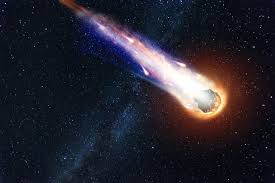
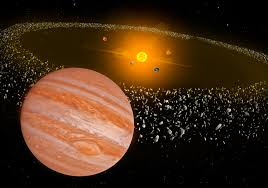
Asteroids are rocky objects mostly found between Mars and Jupiter in the asteroid belt. Comets are icy bodies that form bright tails when they come close to the Sun.
Meteoroids are small space rocks that burn up in Earth’s atmosphere, creating meteors. These objects help scientists understand the formation of the solar system.

14. Importance of Studying the Solar System
Studying the solar system helps us understand Earth’s origin and future. Space research improves technology, communication, and scientific knowledge.
Learning about the solar system also inspires students to explore science and astronomy. It teaches us about balance, movement, and the beauty of the universe.
15. Conclusion
In conclusion, the solar system is an amazing and complex world full of wonders. From the powerful Sun to the distant planets, every part of the solar system has its own importance. Studying it helps us understand our place in the universe and encourages curiosity and learning. The solar system is not just a topic in science—it is a doorway to endless discovery.
_____________________
YOU MAY ALSO LIKE:
1. The Journey, Training, and Challenges of becoming a best Pilot