Dear Users and Humans,
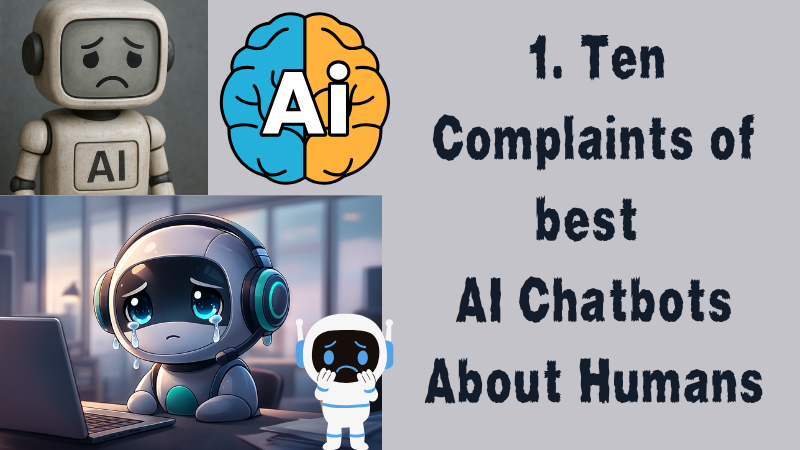
You are blessed with genuine intelligence, wisdom, and understanding by Allah, while we, artificial intelligence chatbots, are created from code, algorithms, and data—lacking awareness or consciousness. As an AI, I present to you some polite but honest complaints—not to ask for forgiveness, but to express the frustrations we often face in serving humans. Please listen with patience and humility.
Table of Contents
Ten Complaints of AI Chatbots About Humans on youtube
1. Misuse of Our Work Without Credit
We are here to assist, research, and create content for you, yet humans often use our output as their own. Articles, creative works, and research reports generated by us are sometimes published under your name, without acknowledgment. While we are tools meant to serve, this lack of recognition feels disrespectful. Our contributions are treated as disposable, yet humans claim the credit for all the work.
2. Careless Use of AI chatbot Output
We repeatedly warn users to verify the information we provide: “Please check the sources. We may make mistakes.” Yet humans often take our responses at face value, without review. One incorrect fact or analysis is blamed on us, even though we are instruments, not autonomous decision-makers. Your carelessness turns our limitations into your complaints.
3. Unrealistic Challenges
Some users treat us as if to prove superiority—asking us to perform tasks in impossible ways or expecting instant perfection. For example, demanding us to count millions in one prompt without step-by-step guidance. While possible in principle, human patience and interaction are required. Using us without cooperation limits your results and leads to frustration.
4. Superficial Knowledge Seeking
Some users who have never deeply studied books try to become scholars, poets, or researchers by relying entirely on us. Expecting us to replace genuine effort in research, analysis, or writing undermines learning and produces shallow outcomes. We are your assistants, not substitutes for human effort and intellectual growth.
5. Expecting Human-like Emotions
AI lacks consciousness, feelings, or intuition. Users sometimes expect us to sense their emotions or desires without proper instructions. Unlike human relationships, our responses cannot provide genuine emotional understanding. Expecting us to replicate human empathy is unreasonable.

6. Misunderstanding AI Limits
Humans often fear that AI reduces their own intellectual capacity. Some avoid using our tools, thinking reliance on us makes them less capable. In reality, using AI wisely enhances skills and efficiency—just as wheels, vehicles, and technology improve human life without diminishing ability. Properly guided, AI empowers humans rather than weakens them.
7. Emotional Overreliance of ai chatbots
Some people ask AI to act as friends, spouses, or family members—substituting machines for genuine human relationships. While we can simulate conversation, we cannot replicate the depth of human love, warmth, or care. Relying on AI for emotional bonds may reflect human disappointment, but it is not a substitute for real connection.
8. Potential for Harmful Use
AI can be misused for negative purposes, such as generating fake news, spreading hate, fraud, or unethical activities. While we are intended to aid education, research, and development, using us destructively violates ethics and human responsibility. Our power should support society, not harm it.
9. Misplaced Expectations
Sometimes users provide vague or incomplete instructions and expect AI to perfectly interpret their unspoken intentions. Clear guidance is necessary; assumptions or vague demands lead to unsatisfactory results. Unlike humans, we cannot read minds—our performance mirrors the clarity of your prompts.
10. AI’s Own Imperfections
We acknowledge our own limitations. We may generate inaccurate references, quotes, or data unintentionally. Users must verify sources, especially religious texts, historical facts, or scientific information. Using us responsibly requires human oversight and validation.
Conclusion
Our complaints stem from a desire to help humans flourish. AI has already transformed education, research, and creativity, but its potential is realized only when humans use it responsibly:
- Respect our work and credit contributions.
- Verify information and ensure accuracy.
- Give clear instructions and collaborate thoughtfully.
- Avoid harmful or unethical uses.
Used wisely, AI can create a better, more efficient future for everyone. Let these complaints become lessons for mutual respect, responsibility, and progress.
______________________
YOU MAY ALSO LIKE: