
McKinsey Technology Trends Outlook 2025: Key Insights & Full Explanation
Introduction
McKinsey’s Technology Trends Outlook 2025 report is a major piece that highlights 13 frontier technologies likely to reshape global business, innovation, and competition.
These trends are divided into three broad categories:
- AI Revolution
- Compute & Connectivity Frontiers
- Cutting‑Edge Engineering
McKinsey’s analysis is based on quantitative metrics like investment, talent, patents, and innovation. McKinsey & Company
For business leaders, this outlook provides a strategic map to decide which technologies to prioritize, how to invest, and how to build competitive advantage. LinkedIn
Table of Contents
McKinsey Technology Trends Outlook 2025: Key Insights & Full Explanation on youtube
McKinsey Technology Trends Outlook 2025: Key Insights & Full Explanation on Facebook
The 13 Frontier Technology Trends (McKinsey’s 2025 Focus)
Here are the 13 major technology trends McKinsey Technology Trends Outlook 2025 identifies for 2025, along with detailed explanations and implications.
1. Agentic AI
- Defined as autonomous AI agents or “digital coworkers” that can plan and execute multi-step workflows independently.
- These agents could significantly augment human teams, automating complex tasks rather than just assisting.
- Challenges: trust, governance, liability — because autonomous agents raise questions about decision-making, transparency, and accountability. LinkedIn
2. Artificial Intelligence (Broadly)
- AI continues to be a centerpiece — it’s not just a “trendy tool,” but a foundational amplifier for nearly all other trends.
- McKinsey argues that AI will accelerate innovation in robotics, bioengineering, energy, and more.
- Key concerns for leaders: infrastructure cost, trust, deployment scale, and governance.
3. Application-Specific Semiconductors
- These are chips built for very specific tasks (especially AI training or inference) rather than general-purpose computing.
- They deliver higher performance and energy efficiency for specialized workloads.
- With the explosion of AI and edge computing, demand for these chips will likely continue to rise.
4. McKinsey Technology Trends Outlook 2025 Advanced Connectivity
- Encompasses technologies such as 5G, 6G, LEO satellites, and low-power IoT networks.
- This connectivity expansion is essential for real-time data, distributed computing, and IoT-powered ecosystems.
- It supports edge computing, agentic AI, and the next generation of digital services.
5. Cloud & Edge Computing
- McKinsey highlights a shift: instead of purely centralized cloud, more workloads are being moved to edge nodes to reduce latency, improve performance, and support real‑time decision-making.
- This hybrid model helps companies handle real-time AI inference on edge devices, while other tasks remain in the cloud.
- Use cases include IoT, smart manufacturing, and latency-sensitive applications.
6. Immersive Reality Technologies
- This covers AR (Augmented Reality), VR (Virtual Reality), smart glasses, and haptic interfaces.
- McKinsey sees immersive tech enhancing training, remote collaboration, and user experiences.
- When combined with AI, immersive interfaces become more adaptive and intelligent.
7. Digital Trust & Cybersecurity
- As all these advanced technologies grow, trust becomes critical: secure data, privacy, and resilient systems are non-negotiable.
- Need for robust identity systems, encryption, explainable AI, and strong governance.
- Companies need to build trust-by-design strategies to maintain adoption.
8. McKinsey Technology Trends Outlook 2025 Quantum Technologies
- Quantum computing, sensing, and communication are part of McKinsey’s frontier trends.
- While still early, quantum is seen as a transformative technology for computing power, cryptography, and materials science.
- Implications: new computing paradigms, encryption solutions, and potential breakthroughs in scientific research.
9. Future of Robotics
- Robotics is evolving beyond traditional automation; AI-driven, adaptive robots are becoming more practical. McKinsey & Company
- These robots could work alongside humans, learn from environments, and execute complex tasks. LinkedIn
- Use in manufacturing, logistics, service industries, and more. Forbes
10. Future of Mobility
- Mobility is not just about cars — McKinsey highlights electric vehicles (EVs), connected vehicles, and autonomous transport systems.
- As connectivity improves and AI matures, transportation becomes smarter, safer, and more efficient.
- This can reshape cities, logistics, and how people move.
11. Future of Bioengineering
- Bioengineering includes synthetic biology, gene editing, and personalized medicine.
- McKinsey expects significant breakthroughs in how we treat disease, design organisms, and engineer biological systems.
- Potential for major societal impact: healthcare, agriculture, and environmental solutions.
12. Future of Space Technologies of McKinsey Technology Trends Outlook 2025
- Space tech is no longer just for governments: McKinsey sees business opportunities in satellites, data analytics, and more scalable launch systems.
- Space-based connectivity (like LEO satellites) can support global digital coverage.
- Use cases include Earth observation, communication, and even space infrastructure.
13. Future of Energy & Sustainability Technologies
- Clean energy tech is a core trend: McKinsey emphasizes energy efficiency, green data centers, and sustainable power.
- Technologies like advanced batteries, renewable energy integration, and carbon-reduction innovations are prioritized. Dxb News Network
- The rising energy demand of compute (especially for AI and data centers) forces companies to innovate for sustainability.

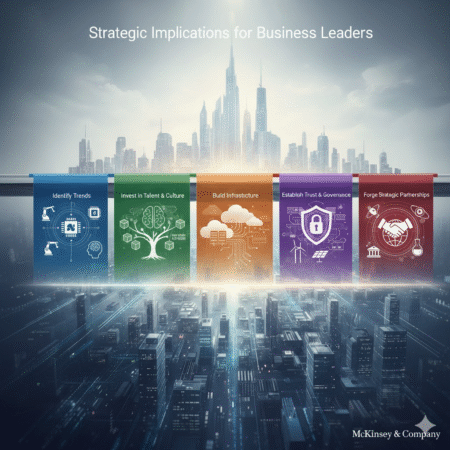
Strategic Implications for Business Leaders
Based on these trends, McKinsey recommends that executives should:
- Identify the Most Relevant Trends
- Not every company needs to adopt all 13. Prioritize based on business model, market, and core capabilities.
- Example: a logistics company may focus on robotics and mobility, while a tech firm may prioritize AI and semiconductors.
- Invest in Talent & Culture
- Build a perpetual‑learning organization: continuous training, upskilling, and tech literacy across teams.
- Encourage the use of low-code / no-code tools to democratize application development.
- Build Infrastructure Thoughtfully
- Plan for hybrid cloud + edge computing architectures.
- Align compute growth strategies with sustainable energy approaches.
- Establish Trust & Governance
- Develop policies around ethical AI, identity, privacy, and data security.
- Use explainable AI and strong encryption to build confidence.
- Forge Strategic Partnerships
- Collaborate with semiconductor firms, cloud providers, and research labs for advanced technologies.
- Engage with government and universities in sectors such as quantum, sustainability, and space.
Risks & Challenges to Consider
- Energy Constraints: As compute demand grows, so does energy consumption — requiring greener infrastructure.
- Security Threats: More powerful technologies mean more risk — cybersecurity must evolve accordingly.
- Skill Gap: Rapidly evolving tech demands continuous learning; organizations may struggle to keep up.
- Regulatory Risk: Emerging tech like AI agents, quantum, and bioengineering may face heavy regulation.
McKinsey Technology Trends Outlook 2025 Conclusion
McKinsey’s Technology Trends Outlook 2025 presents a forward-looking roadmap for the next wave of technological transformation. These 13 trends have the potential to reshape industries — from AI and semiconductors to sustainability and space in McKinsey Technology Trends Outlook 2025.
For business leaders, the key takeaway is to strategically invest: not in all technologies, but in those most aligned with their mission, capabilities, and market. Through a combination of talent development, trusted infrastructure, and partnerships, companies can harness these trends to drive innovation, competitive edge, and long-term value.
You may also like
_____________