AI-Native Development Platforms: A Comprehensive Exploration of the Future of Software Engineering
Introduction
The evolution of software development has always been closely tied to technological progress. From early procedural programming to object-oriented paradigms, from cloud computing to DevOps, each phase has reshaped how digital systems are created and maintained. Today, the industry stands at the threshold of another major transformation: AI-Native Development Platforms.
Unlike earlier innovations that enhanced productivity incrementally, AI-native platforms represent a structural shift. They redefine not only how software is built, but also who can build it, how fast it can be deployed, and how intelligently it can evolve. These platforms integrate artificial intelligence into the very foundation of development, making intelligence an inherent property of software creation rather than an optional enhancement.
Understanding AI-Native Development Platforms
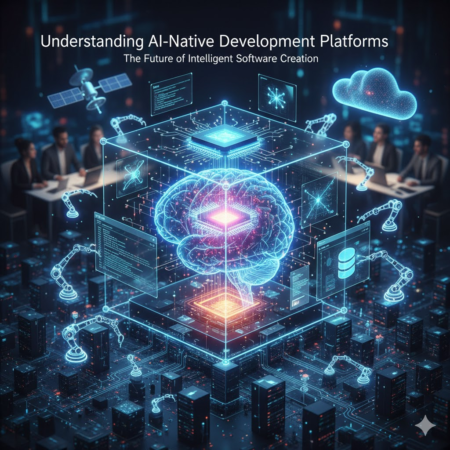
An AI-Native Development Platform is a development environment designed around artificial intelligence as its core operational engine. Instead of treating AI as an external module or third-party integration, these platforms embed AI deeply into every stage of the software lifecycle.
They combine multiple AI disciplines, including:
- Machine Learning
- Natural Language Processing (NLP)
- Predictive Analytics
- Automated Reasoning
- Intelligent Decision Systems
As a result, AI-native platforms are capable of understanding human intent, learning from data, predicting outcomes, and continuously improving applications without constant human intervention.
In essence:
Traditional platforms execute instructions; AI-native platforms interpret goals.
Table of Contents
Evolution from Traditional to AI-Native Development
To fully appreciate the significance of AI-native platforms, it is important to examine how they differ from traditional development environments.
Traditional Development Model
Traditional software development relies heavily on:
- Explicit logic written by developers
- Fixed workflows and predefined rules
- Manual debugging and testing
- Human-driven optimization
While powerful, this model is time-consuming, resource-intensive, and prone to human error.
AI-Native Development Model
AI-native platforms introduce:
- Goal-oriented development
- Automated logic generation
- Intelligent error prediction
- Adaptive and self-learning systems
This transition marks a shift from instruction-based development to intelligence-based development.
Core Characteristics of AI-Native Development Platforms
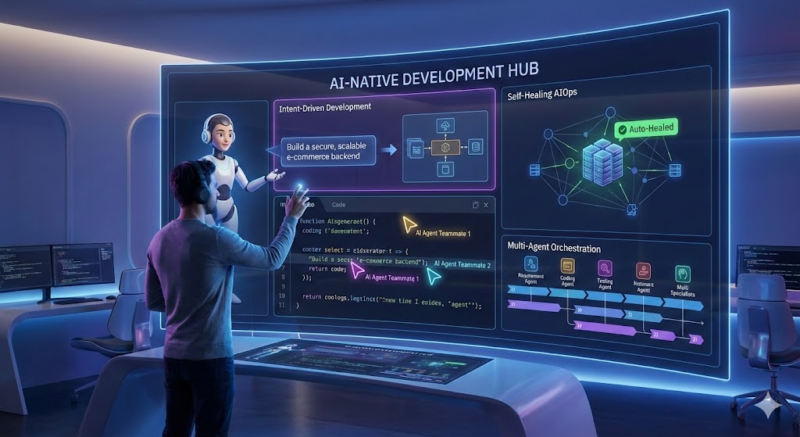
1. Prompt-Driven and Intent-Based Development
AI-Native Development Platforms One of the most revolutionary features of AI-native platforms is prompt-driven development. Developers and non-developers alike can describe requirements in natural language.
For example:
“Build a scalable application to manage student enrollment, fees, attendance, and reporting.”
The platform interprets the intent and automatically:
- Designs database schemas
- Suggests workflows
- Creates UI components
- Generates backend logic
This significantly reduces technical complexity and democratizes software creation.
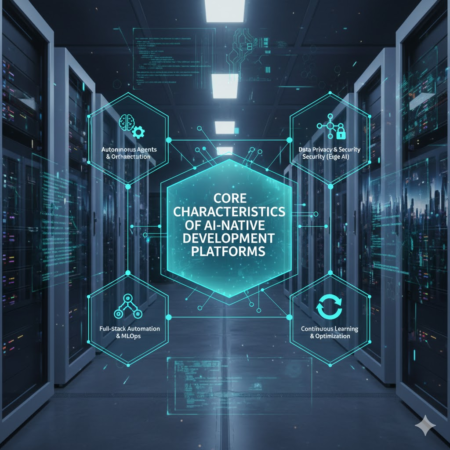
2. Automated and Intelligent Code Generation
AI-Native Development Platforms AI-native platforms are capable of generating:
- Clean, readable, and maintainable code
- Optimized algorithms
- Secure authentication flows
- Scalable architectural patterns
They also learn from existing codebases and industry best practices, ensuring higher-quality outputs. Developers transition from writing repetitive code to reviewing, guiding, and refining AI-generated solutions.
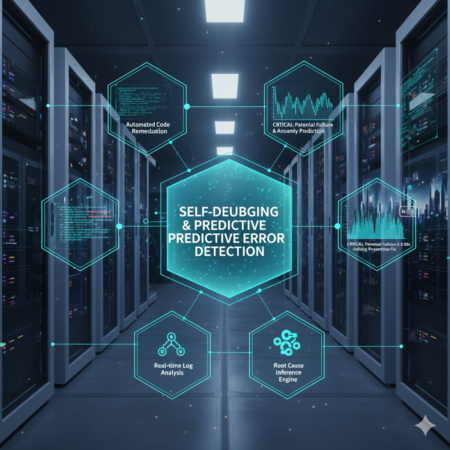
3. Self-Debugging and Predictive Error Detection
Traditional debugging is reactive—errors are found after they occur. AI-native platforms adopt a proactive approach by:
- Predicting bugs before execution
- Detecting logic inconsistencies
- Identifying performance bottlenecks early
- Flagging security vulnerabilities
This predictive capability dramatically improves reliability and reduces post-deployment failures.
4. Continuous Learning and Adaptation
AI-native platforms do not remain static after deployment. They continuously analyze:
- User interactions
- Performance metrics
- System logs
- Business outcomes
Using this data, they adapt workflows, optimize performance, and recommend improvements. Applications built on AI-native platforms effectively evolve over time, aligning themselves with real-world usage patterns.
AI-Native Platforms and the Software Development Lifecycle
AI-native development impacts every phase of the software lifecycle:
Planning and Design
AI assists in:
- Requirement analysis
- Feasibility assessment
- Architecture recommendations
Development
- Automated coding
- Real-time optimization
- Intelligent refactoring
Testing
- Automated test case generation
- Intelligent regression testing
- Risk-based testing strategies
Deployment and Maintenance
- Smart deployment pipelines
- Automated monitoring
- Self-healing systems
This holistic integration makes AI-native platforms uniquely powerful.
Economic and Business Impact
AI-native development platforms have profound economic implications:
AI-Native Development Platforms Reduced Development Costs
- Smaller development teams
- Less manual testing
- Faster turnaround times
Faster Innovation Cycles

Businesses can:
- Launch products quickly
- Experiment with ideas at low risk
- Respond rapidly to market changes
Startup Enablement
AI-native platforms lower entry barriers, enabling startups to compete with established enterprises using fewer resources.
Relevance for Developing Countries
For developing nations such as Pakistan, AI-native development offers transformative potential:
- Expansion of the freelancing economy
- Empowerment of students and educators
- Rapid digitization of public and private services
- Creation of localized and multilingual applications
Educational platforms, healthcare systems, financial tools, and governance applications can be developed efficiently, addressing local needs with global standards.
Impact on the Workforce and Future Skills
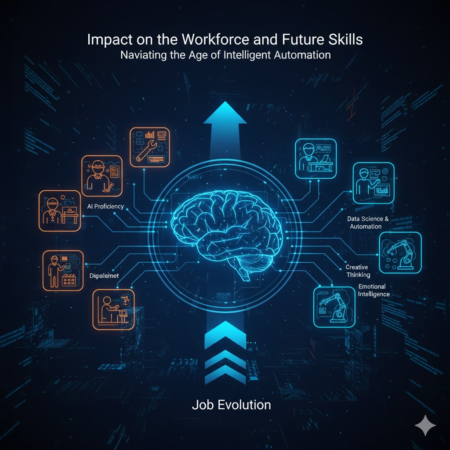
Contrary to common fears, AI-native platforms do not eliminate jobs; they reshape them.
Emerging Skill Sets
- AI Prompt Engineering
- AI-Assisted System Design
- Ethical AI Governance
- Human-AI Collaboration
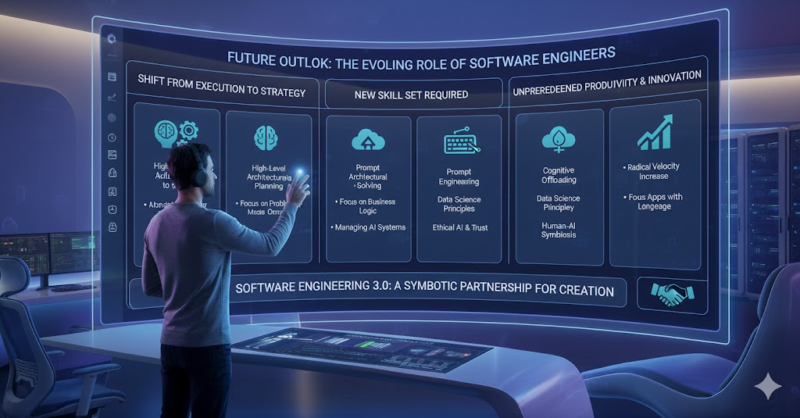
Developers of the future will act as strategists, architects, and supervisors, guiding intelligent systems rather than competing with them.
Ethical, Legal, and Technical Challenges
Despite their advantages, AI-native platforms introduce new challenges:
- Data privacy and ownership
- Algorithmic bias and fairness
- Transparency of AI decisions
- Overdependence on automation
Addressing these concerns requires strong governance frameworks, ethical guidelines, and human oversight.
Future Outlook
The future of AI-native development is expansive and transformative. In the coming years:
- Applications will self-improve autonomously
- Development cycles will become near-instant
- Collaboration between humans and AI will deepen
- Software systems will become more adaptive and resilient
AI-native platforms will not merely support developers—they will co-create digital solutions.
Conclusion
AI-Native Development Platforms represent a paradigm shift in software engineering. By embedding intelligence at the core of development, they transform software creation into a faster, smarter, and more inclusive process.
They:
- Redefine productivity
- Democratize innovation
- Reduce costs
- Accelerate digital transformation
Ultimately, AI-native platforms are not just tools of the future—they are the foundation of the next digital civilization.
You may also like
_______________
McKinsey Technology Trends Outlook 2025: Key Insights & Full Explanation