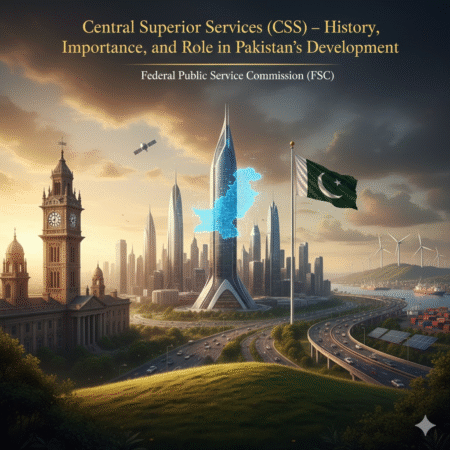
Central Superior Services (CSS) – History, Importance, and Role in Pakistan’s Development
The Central Superior Services (CSS) is widely regarded as Pakistan’s most prestigious civil service. More than just an examination, CSS forms the backbone of Pakistan’s federal administration. Officers recruited through CSS are entrusted with managing government departments, implementing national policies, and serving millions of citizens. For ambitious youth, CSS represents not only a career but also a path to leadership, national contribution, and personal growth.
1. Introduction to CSS
The CSS exam is conducted annually by the Federal Public Service Commission (FPSC). Candidates who pass are selected for BPS-17 positions in federal government departments, where they start a journey of administrative responsibility and governance. These officers are the country’s key decision-makers, working across diverse sectors like administration, police, foreign affairs, finance, customs, and information.

The value of CSS lies in its merit-based selection, rigorous evaluation, and opportunities for growth. Unlike many jobs that may rely on connections or influence, CSS ensures that knowledge, skill, and dedication are rewarded.
Table of Contents
Central Superior Services (CSS) – History, Importance, and Role in Pakistan’s Development on youtube
2. History of Central Superior Services (CSS) – Who Started It and Why
The CSS system has its roots in the British colonial era. The British administration needed a professional civil service to manage the vast territories of India efficiently. This system emphasized:
- Competence
- Training
- Merit-based recruitment
After Pakistan’s independence in 1947, the new government recognized the urgent need to continue a structured bureaucratic system. The goal was to ensure:
- Qualified officers managed critical departments
- Policies were implemented fairly and efficiently
- Administration remained stable and consistent despite political changes
Over the decades, CSS has evolved, adapting to modern governance needs, including new occupational groups, updated exam patterns, and training programs for leadership and management skills.
3. Why Central Superior Services (CSS) Was Needed in Pakistan
At the time of independence, Pakistan faced multiple challenges:
- Limited administrative capacity
- Political instability
- Scarcity of trained personnel
- Need for governance systems to serve citizens effectively
CSS was introduced to create a merit-based bureaucracy, ensuring that only capable, trained individuals entered government service. It also provided stability and professionalism, reducing the risks of nepotism and favoritism.
Through CSS, Pakistan could build a cadre of officers capable of:
- Running districts efficiently
- Implementing development projects
- Managing law and order
- Representing Pakistan abroad
4. CSS Structure and Selection Process
The CSS selection process is rigorous, ensuring only the most deserving candidates succeed. It includes the following stages:
a) Written Examination
- Includes 6 compulsory subjects and optional subjects chosen by candidates.
- Passing criteria: 40% in compulsory, 33% in optional, and 50% overall.
- Written exams test knowledge, analytical thinking, and clarity of expression.
b) Medical Examination
- Ensures candidates are physically fit for government service.
- Important for certain field roles that may require travel, inspections, or operational tasks.
c) Psychological Assessment
- Includes personality tests, group discussions, and problem-solving exercises.
- Evaluates leadership potential, confidence, decision-making, and communication skills.
d) Viva Voce (Interview)
- Conducted by a panel of experts, testing current affairs knowledge, general understanding, reasoning, and personality.
- Assesses the candidate’s confidence, presence of mind, and suitability for administrative responsibilities.
e) Final Merit List
- Combined scores from the written exam and interview determine placement.
- Candidates are then assigned to one of 12 occupational groups, based on their merit and preferences.
5. Occupational Groups and Career Paths for Central Superior Services (CSS)
Central Superior Services (CSS) officers are placed into 12 occupational groups, each managing different government functions:
- Pakistan Administrative Service (PAS) – District administration, policy implementation.
- Police Service of Pakistan (PSP) – Law enforcement, crime prevention, public safety.
- Foreign Service of Pakistan (FSP) – Diplomacy, international representation, trade negotiations.
- Inland Revenue Service (IRS) – Taxation, revenue collection, financial policy.
- Customs Service – Border control, trade regulations, customs enforcement.
- Information Group – Media management, government communications.
- Audit & Accounts – Financial audits, budget monitoring, accountability.
- Commerce & Trade Group – Trade policies, business regulations, international commerce.
9–12. Other specialized groups – Include posts in development, agriculture, defense, and strategic policy sectors.
Career progression:
- Starting position: BPS-17 officer
- Mid-career: Additional Secretary, District Coordination Officer (DCO), or Inspector General (IG)
- Senior positions: Federal Secretary, Ambassador, Cabinet Advisor
CSS offers both vertical growth in positions and lateral opportunities across departments, making it a versatile career choice.
6. The Value of Central Superior Services (CSS) in Pakistan
CSS holds immense value for individuals and the nation:
- Prestige and Respect: Officers are highly regarded in society for their expertise and responsibility.
- Meritocracy: Success is based purely on knowledge, skill, and dedication.
- Impactful Career: Officers influence policy, governance, law enforcement, and international affairs.
- Leadership Opportunities: CSS trains officers to manage large teams and complex projects.
- Nation-Building: Officers contribute directly to Pakistan’s economic development, social welfare, and international reputation.
7. Benefits CSS Officers Bring to Pakistan
- Efficient Governance: Smooth operation of federal and provincial departments.
- Policy Implementation: Turning government plans into action that impacts millions.
- Stability and Accountability: Reduces corruption and ensures fair administration.
- International Representation: Diplomats and foreign service officers promote Pakistan abroad.
- Public Welfare Projects: Officers oversee education, health, infrastructure, and social services.
- Law and Order: Police service and administrative officers maintain security and public safety.
8. Topper Inspiration: Muhammad Shafay Ijaz
The Central Superior Services (CSS) 2025 topper, Muhammad Shafay Ijaz, a NUST SEECS student, is an inspiration for aspirants:
- Scored 1st position nationwide
- Honored by the Deputy Commissioner of Sialkot
- Featured in the November 2025 issue of Jahangir’s World Times, sharing his preparation strategies
- Demonstrates the power of consistency, smart planning, and dedication
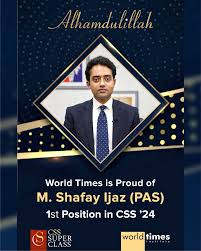
Shafay’s success shows that CSS is achievable for anyone with discipline, focus, and passion.
9. Why Aim for CSS? Lessons from Toppers
Central Superior Services (CSS) is more than a career:
- Serve the Nation: Contribute directly to Pakistan’s administration and welfare.
- Earn Respect: Gain authority and social prestige.
- Develop Leadership: Manage districts, policies, and national projects.
- Inspire Others: Motivate youth and set a national example.
- Achieve Personal Growth: Develop knowledge, confidence, and decision-making skills.
- Secure Financial Stability: Government benefits, salary, and long-term growth.
Topper stories like Shafay Ijaz prove that CSS is a gateway to both personal success and national service.
10. Conclusion
The Central Superior Services (CSS) is the backbone of Pakistan’s administrative system. Introduced to ensure meritocracy, stability, and efficiency, it continues to shape the country’s governance. CSS officers play critical roles in administration, law, public welfare, diplomacy, and development, making them indispensable to Pakistan’s progress.
With dedicated preparation and a clear vision, aspirants can follow in the footsteps of toppers like M. Shafay Ijaz, serving both their personal ambitions and the nation. CSS is not just an exam; it is a career of purpose, leadership, and national impact.
You may also like
_______________
McKinsey Technology Trends Outlook 2025: Key Insights & Full Explanation