
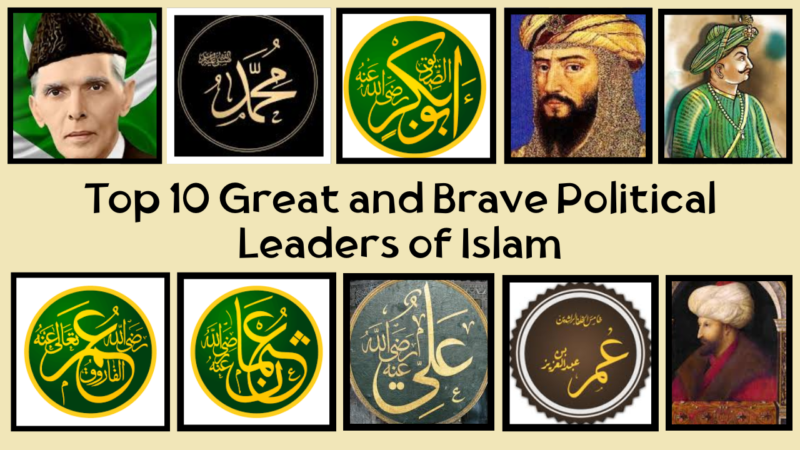
Islamic history is filled with outstanding political leaders who ruled with courage, justice, wisdom, and moral strength. These leaders were not only brave in battles but also fearless in speaking the truth, protecting human rights, and standing against injustice. Their political leadership shaped societies and laid strong foundations for governance based on fairness and accountability.
This article discusses ten great and brave political leaders of Islam, along with a short incident from each leader’s life that reflects their courage and leadership.
Table of Contents
Top 10 Great and Brave Political Leaders of Islam on youtube
Summary Table: Brave Political Leaders of Islam
| No. | Leader | Time Period | Key Leadership Quality | Major Contribution |
|---|---|---|---|---|
| 1 | Prophet Muhammad (ﷺ) | 7th Century | Mercy & Justice | Islamic State of Madinah |
| 2 | Abu Bakr Siddiq (RA) | 7th Century | Firm Faith | Unity of Muslims |
| 3 | Umar ibn al-Khattab (RA) | 7th Century | Justice | Strong Administration |
| 4 | Uthman ibn Affan (RA) | 7th Century | Patience | Preservation of Qur’an |
| 5 | Ali ibn Abi Talib (RA) | 7th Century | Wisdom | Moral Governance |
| 6 | Salahuddin Ayyubi | 12th Century | Courage & Mercy | Liberation of Jerusalem |
| 7 | Umar ibn Abdul Aziz | 8th Century | Honesty | Welfare Reforms |
| 8 | Sultan Mehmed II | 15th Century | Determination | Conquest of Constantinople |
| 9 | Tipu Sultan | 18th Century | Resistance | Anti-Colonial Leadership |
| 10 | Muhammad Ali Jinnah | 20th Century | Constitutional Courage | Creation of Pakistan |
1. Prophet Muhammad (ﷺ)
Prophet Muhammad (ﷺ) was the greatest political and moral leader in Islamic history. As the head of the Islamic state of Madinah, he established justice, equality, and consultation (Shura). The Charter of Madinah ensured peaceful coexistence among Muslims, Jews, and other communities.
Short Incident:
At the conquest of Makkah, Prophet Muhammad (ﷺ) had complete power over his enemies, yet he forgave them all. This act of mercy showed unmatched political bravery and wisdom.
2. Hazrat Abu Bakr Siddiq (RA)
Hazrat Abu Bakr (RA) became the first Caliph after the death of the Prophet (ﷺ). His rule faced serious challenges, including rebellions and refusal to pay Zakat. He stood firm and protected Islamic principles.
Short Incident:
When advised to be lenient with tribes refusing Zakat, he said, “If they withhold even a rope they used to give, I will fight them.” His courage preserved the unity of Islam.
3. Hazrat Umar ibn al-Khattab (RA)
Hazrat Umar (RA) is remembered as one of the most just rulers in history. He introduced a strong administrative system and ensured accountability of governors.
Short Incident:
While patrolling at night, he heard a woman refusing to cheat customers because Umar had forbidden it. This incident reflects his just leadership and moral influence on society.
4. Hazrat Uthman ibn Affan (RA)
Hazrat Uthman (RA) ruled during a time of political tension. His most important achievement was the standardization of the Qur’an, which preserved unity among Muslims.
Short Incident:
When rebels attacked his house, he refused to fight back to prevent Muslim bloodshed. He was martyred while reciting the Qur’an—an example of patience and courage.
5. Hazrat Ali ibn Abi Talib (RA)
Hazrat Ali (RA) was known for his wisdom, bravery, and deep understanding of justice. His guidance on governance remains influential.
Short Incident:
He once lost his armor and found it with a Jewish man. In court, the judge ruled against Ali due to lack of evidence. Ali accepted the decision, showing equality before law.
6. Salahuddin Ayyubi
Salahuddin Ayyubi united the Muslim world and recaptured Jerusalem from Crusaders. He is respected even by Western historians for his mercy.
Short Incident:
After conquering Jerusalem, he allowed Christians to leave safely and protected their holy places, proving that true bravery includes compassion.
7. Umar ibn Abdul Aziz
Umar ibn Abdul Aziz is often called the Fifth Rightly Guided Caliph. He ruled with simplicity and justice, returning stolen wealth to the public treasury.
Short Incident:
He refused to use government oil for personal purposes, saying it belonged to the people. This honesty made his leadership exceptional.
8. Sultan Mehmed II (Mehmed the Conqueror)
Sultan Mehmed II conquered Constantinople at the age of 21. His determination and strategic brilliance made him a legendary political leader.
Short Incident:
After the conquest, he protected religious minorities and allowed freedom of worship, demonstrating political wisdom and tolerance.
9. Tipu Sultan
Tipu Sultan was a fearless ruler who resisted British colonialism in India. He modernized his army and promoted technological advancement.
Short Incident:
He famously said, “It is better to live one day as a tiger than a hundred years as a sheep.” He died fighting rather than surrendering.
10. Muhammad Ali Jinnah
Muhammad Ali Jinnah led Muslims of the subcontinent through peaceful political struggle. His vision resulted in the creation of Pakistan.
Short Incident:
Despite severe illness, he continued negotiations tirelessly, showing remarkable determination and political courage.
Conclusion
These ten great and brave political leaders of Islam proved that leadership is not about power but responsibility. Their courage, justice, and moral strength continue to inspire the world. They showed that Islamic political leadership stands for fairness, humanity, and service to society.
_____________________
YOU MAY ALSO LIKE:
1. Village Life vs City Life: Two Different Worlds which is better?